
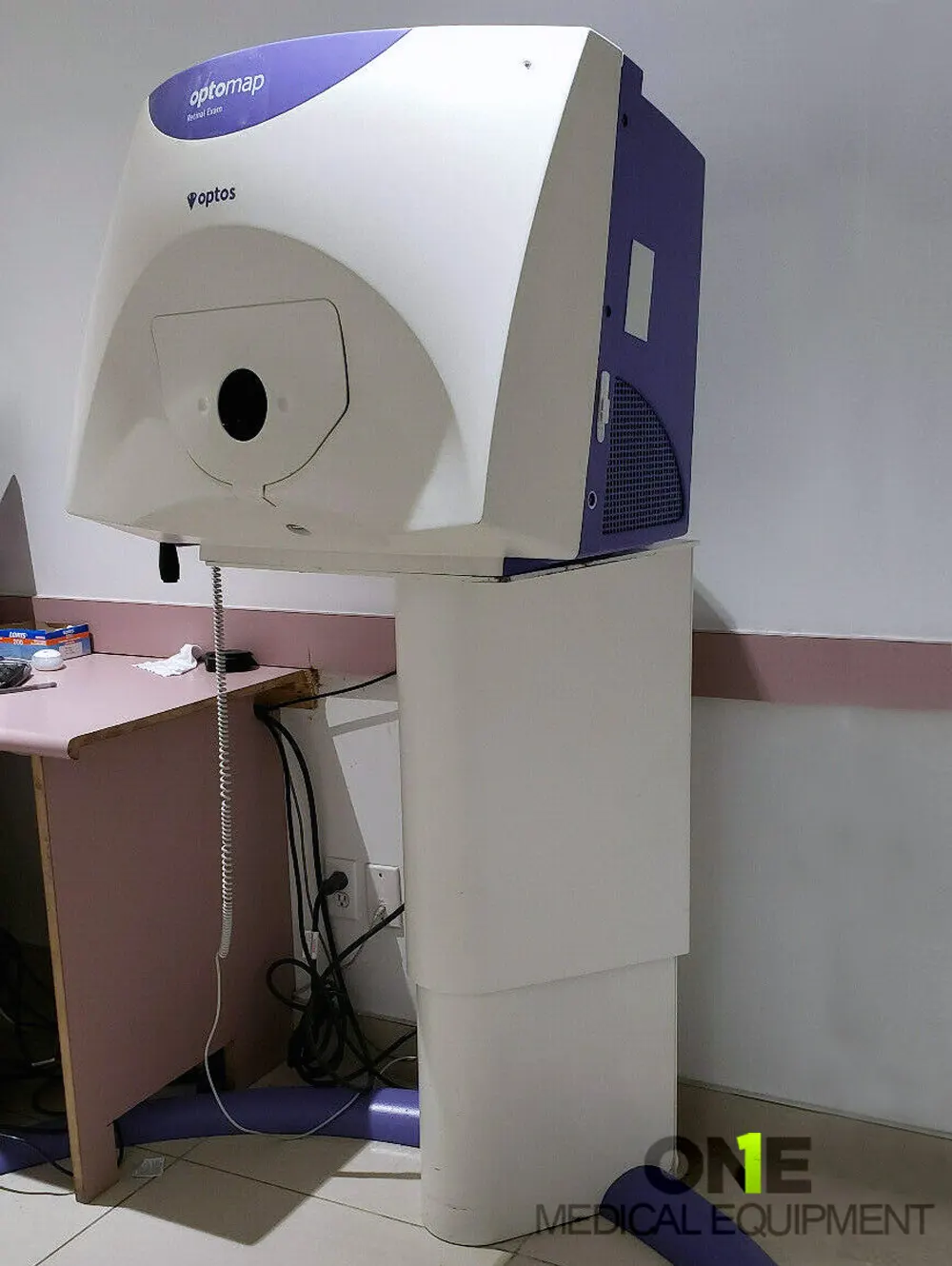
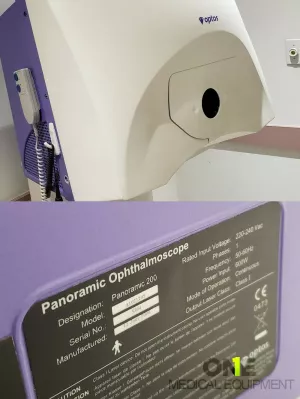
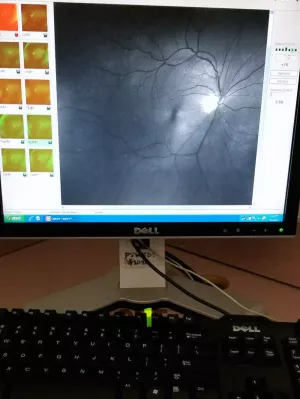
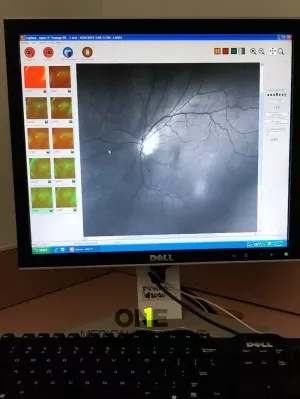
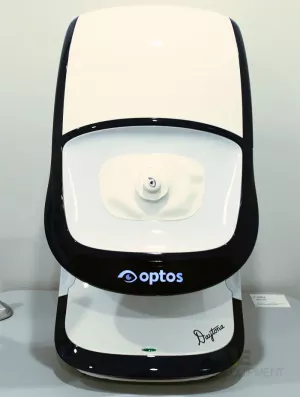
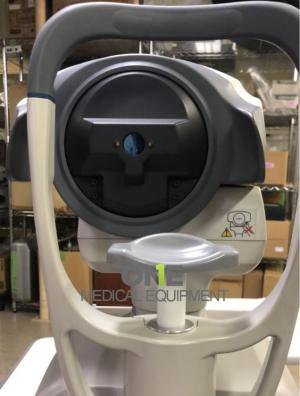
Pre-Owned Optos Panoramic 200 Retinal Imaging System for sale, Excellent Patient Ready for Immediate Use, Professionally refurbished, calibrated, and fully patient-ready. Includes warranty, installation support.
Bring world-class retinal imaging to your clinic at a fraction of the new-equipment price. This excellent pre-owned Optos Panoramic 200 retinal imaging system offers the same ultra-widefield performance that made Optos a global leader in ophthalmic diagnostics, now refurbished, calibrated, and certified patient-ready for immediate installation. Perfect for ophthalmology practices, optometry offices, and diagnostic imaging centers seeking premium technology with smart savings.
Includes;
- Optos Panoramic 200 main unit (refurbished and tested)
- Certified calibration certificate and performance report
- Computer interface and software installation support
- Power cord & necessary connection cables
- User manual / operator guide (PDF + print)
- 6 month warranty
- Professional packing & global shipping available
Optos Panoramic 200 Retinal Imaging: Revolutionizing Eye Health Diagnostics
Optos Panoramic 200 Retinal Imaging system transforms eye examinations with ultra-widefield imaging technology. Learn its features, benefits, clinical applications, and how it compares to traditional fundus cameras.
Retinal imaging is an essential component of modern ophthalmic care. Detecting subtle changes in the retina can help diagnose vision-threatening diseases such as diabetic retinopathy, glaucoma, or macular degeneration long before symptoms appear.
Among today’s leading innovations, the Optos Panoramic 200 Retinal Imaging system stands out for its ability to provide a 200° ultra-widefield view of the retina in a single capture — a feat unmatched by most conventional fundus cameras.
This article explores what the Optos Panoramic 200 is, how it works, its advantages, and why it has become an indispensable tool for eye-care professionals worldwide.
What Is the Optos Panoramic 200 Retinal Imaging System?
The Optos Panoramic 200, also known as Optos P200 or Optomap, is a non-mydriatic ultra-widefield retinal imaging device developed by Optos plc, a UK-based company specializing in eye health imaging technologies.
Unlike standard fundus cameras that capture only 30–50° of the retina, the Optos system images up to 200° (approximately 82% of the retinal surface) in a single shot. This wide coverage enables clinicians to identify peripheral retinal pathologies that are often invisible in conventional images.
How the Optos Panoramic 200 Works
The Optos Panoramic 200 utilizes Scanning Laser Ophthalmoscopy (SLO), a non-invasive technique that uses laser light to scan the retina.
Dual-Wavelength Laser Imaging
It employs two separate laser wavelengths:
- Red (633 nm): penetrates deeper retinal layers, providing details of the choroid.
- Green (532 nm): highlights superficial retinal structures, including blood vessels and nerve fiber layers.
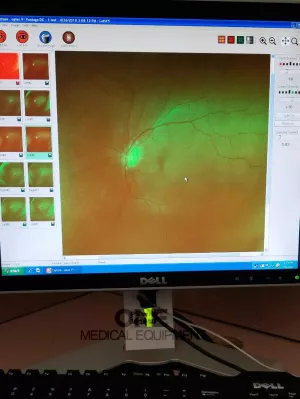
These two images are then combined into a composite digital image known as an Optomap, providing a detailed, multi-layered view of the retina.
Non-Mydriatic Capture
Unlike traditional retinal cameras that often require dilation drops, the Optos P200 can typically image the retina without pupil dilation. This greatly improves patient comfort and examination speed.
| Feature | Description |
|---|---|
| Ultra-Widefield Imaging | Captures up to 200° of the retina in one shot — over 4x the area of traditional fundus images. |
| Dual-Laser SLO Technology | Uses red and green lasers for deep and superficial retinal visualization. |
| Non-Mydriatic | Eliminates the need for dilation in most patients, enabling faster exams. |
| Digital Integration | Stores images electronically and integrates with EMR systems for documentation and comparison. |
| Autofluorescence Option | Some models include fundus autofluorescence (FAF) to assess retinal pigment epithelium health. |
| Real-Time Viewing | Clinicians can instantly analyze images and detect pathologies during patient visits. |
Clinical Applications
The Optos Panoramic 200 is widely used in ophthalmology and optometry for early detection and monitoring of numerous conditions, including:
- Diabetic Retinopathy – Detects microaneurysms, hemorrhages, and neovascularization across peripheral regions.
- Age-Related Macular Degeneration (AMD) – Monitors drusen and pigment epithelial changes.
- Retinal Tears and Detachments – Identifies peripheral lesions invisible to standard fundus imaging.
- Glaucoma – Assesses optic nerve head and nerve fiber layer integrity.
- Hypertensive Retinopathy – Visualizes vascular narrowing and arteriovenous changes.
- Retinal Degeneration – Detects pigmentary changes and lattice degeneration in the far periphery.
The Optos Panoramic 200 Retinal Imaging system represents a major advancement in ocular diagnostics. By offering a 200-degree ultra-widefield, non-dilated, high-resolution image of the retina, it enables eye-care professionals to detect, monitor, and treat retinal diseases earlier and more accurately.
For clinics aiming to elevate diagnostic standards and patient care efficiency, integrating Optos technology is a forward-looking investment in the future of retinal health.